In today’s fast-moving digital world, search is changing fast. Search engines are no longer just matching keywords. They are trying to understand meaning, context, and intent. This is where Schema Markup for AI Search becomes a powerful tool. If you want your website to stay ahead, you must learn how structured data works.
In fact, experts like Golam Murshed Jony highlight that modern SEO is no longer just about links and keywords. It is about helping machines understand your content clearly.
What Is Schema Markup?
Schema markup is a type of code. You add it to your website. It helps search engines understand your content better. It uses a shared vocabulary. This vocabulary is known as structured data.
Simple example:
- A normal page says “Apple.”
- Schema tells if it is a fruit or a company.
This clarity helps search engines show better results.
Why Schema Matters in AI Search
AI search systems are smart. AI search systems do more than match words. Instead, they aim to understand meaning and context. By connecting entities and user intent, they deliver smarter results.
Schema markup helps in three key ways:
1. Better Understanding
Search engines read your content faster. They know what your page is about.
2. Rich Results
Schema enables rich snippets. These include:
- Ratings
- FAQs
- Product details
- Reviews
These results stand out. They get more clicks.
3. AI-Friendly Content
AI tools prefer structured data. It helps them answer questions quickly. Your content becomes more usable for AI-generated answers.
The Rise of AI Search
Search is changing fast. Tools powered by AI are growing every day. These systems include:
- AI chat interfaces
- Voice assistants
- Smart search engines
They do not rely only on traditional ranking signals. They use:
- Context
- Entity relationships
- Structured data
Schema markup fits perfectly into this system.
How Schema Helps Future SEO
Future SEO is not just about ranking. It is about visibility across platforms. Schema markup plays a big role here.
1. Entity-Based SEO
Search engines now focus on entities. An entity is a real-world object. It can be:
- A person
- A brand
- A product
Schema helps define these clearly.
Example:
- Your name becomes a recognized entity.
- Your brand gets connected to your services.
2. Voice Search Optimization
Voice search is growing fast. People ask questions in natural language.
Schema helps by:
- Structuring answers
- Highlighting key data
- Making content easy to read
This increases your chances of being selected as a voice answer.
3. Featured Snippets and AI Overviews
Schema improves your chances of appearing in:
- Featured snippets
- AI-generated summaries
These positions get high visibility. They often appear above normal results.
4. Improved Click-Through Rate (CTR)
Rich results attract attention. Users are more likely to click structured listings.
This improves:
- Traffic
- Engagement
- Conversions
Types of Schema Markup You Should Use
Not all schema types are equal. Some are more useful for SEO and AI search.
1. Article Schema
Best for blog posts. It helps search engines understand:
- Author
- Publish date
- Topic
2. FAQ Schema
Great for answering user questions. It improves chances of showing in rich results.
3. Product Schema
Important for eCommerce. It includes:
- Price
- Availability
- Reviews
4. Organization Schema
Defines your brand. It helps build trust and recognition.
5. Person Schema
Useful for personal branding. It builds authority around your name.
6. Local Business Schema
Helps local SEO. It shows:
- Address
- Phone
- Business hours
How to Implement Schema Markup
Adding schema is easier than most people think.
Step 1: Choose the Right Type
Select schema based on your content.
Step 2: Use JSON-LD Format
This is the most recommended format. It is clean and easy to manage.
Step 3: Add Code to Your Website
Place the schema in your page HTML.
Step 4: Test Your Markup
Use tools like structured data testing tools. Check for errors.
Step 5: Monitor Performance
Track:
- Impressions
- CTR
- Rankings
Schema and E-E-A-T
E-E-A-T stands for:
- Experience
- Expertise
- Authoritativeness
- Trust
Schema supports all these factors.
Experience
Schema highlights real content and authors.
Expertise
It connects your content to your niche.
Authority
It builds entity recognition over time.
Trust
Clear data builds credibility.
Common Mistakes to Avoid
Many people use schema incorrectly. Avoid these mistakes:
1. Wrong Schema Type
Do not use irrelevant schema. It confuses search engines.
2. Missing Required Fields
Incomplete schema reduces effectiveness.
3. Spammy Markup
Do not add fake reviews or ratings.
4. No Updates
Keep your schema updated. Old data harms SEO.
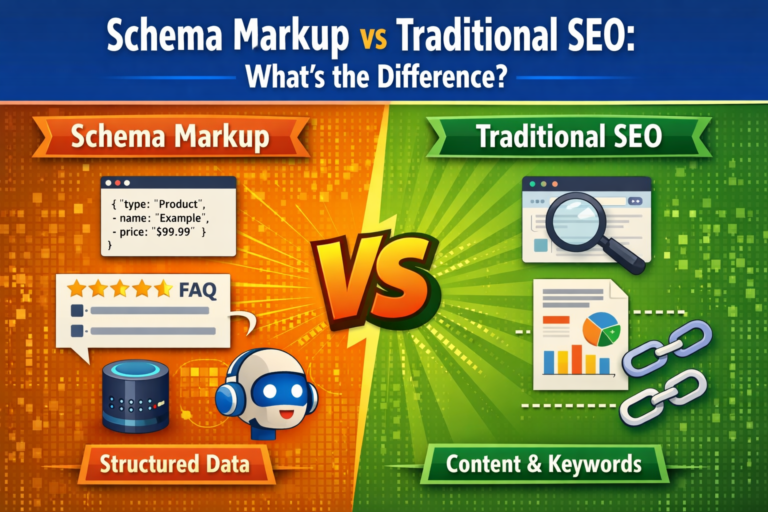
Schema Markup vs Traditional SEO
Traditional SEO focuses on:
- Keywords
- Backlinks
- Content
Schema adds a new layer:
- Structure
- Context
- Meaning
Both are important. But future SEO will rely more on structured data.
Read More On: Schema Markup vs Traditional SEO
Schema in AI Content Systems
AI systems use structured data to:
- Generate answers
- Summarize content
- Recommend sources
If your site has schema:
- AI trusts it more
- AI uses it more
- AI shows it more
This increases your visibility beyond search engines.
The Role of Knowledge Graphs
Knowledge graphs connect data points. They show relationships between entities.
Schema helps you:
- Enter the knowledge graph
- Build connections
- Improve brand recognition
This is key for long-term SEO success.
Real Benefits of Schema Markup
Let’s look at practical benefits:
- Higher rankings over time
- Better CTR
- Improved user experience
- More visibility in AI tools
- Strong brand authority
These benefits make schema a must-have.
Must Read This The Benefits of Using Schema Markup for SEO to Win Business Fast.
Future Trends in SEO and AI
SEO is changing very fast. New tools and smart systems are shaping search. Here are some key trends you should know:
- Search Without Clicking
Many users now get answers on the search page. They do not click links. Search engines show quick answers at the top. Schema helps your content appear in these results. - Growth of AI Assistants
More people use AI tools every day. These tools give fast and clear answers. They use structured data to understand content better. Schema helps AI read your site easily. - Context-Based Ranking
Search engines now focus on meaning. They do not only look at keywords. They try to understand user intent. Clear and helpful content ranks better. - Visual and Voice Search
People use voice and images to search. This trend is growing fast. Schema helps search engines understand images and voice queries.
Why You Should Start Now
Schema markup is not new. But its importance is growing fast.
If you start now:
- You stay ahead of competitors
- You build long-term authority
- You prepare for AI-driven search
If you ignore it:
- You lose visibility
- You fall behind
Simple Strategy for Beginners
If you are new, follow this simple plan:
- Start with basic schema
- Focus on key pages
- Use clean JSON-LD
- Test regularly
- Expand gradually
Consistency is more important than speed.
Final Thoughts
Schema markup is the bridge between your content and AI understanding. It gives your website a clear structure. It helps search engines and AI systems trust your data.
Future SEO is not just about ranking pages. It is about becoming a trusted source of information. Structured data makes this possible.
If you want to grow in AI search, you must adapt now. Learn schema. Use it wisely. Improve it over time.
As the digital world becomes more intelligent, only well-structured content will survive and grow. Following the right strategy with Golam Murshed Jony as an ai seo expert can help you stay ahead in this new era of search.